Lender desk
One curated inbox for Swiss real-estate financing — structured, not scattered across email
From scattered deal flow to an ordered financing inbox: every open tranche with real economics, every offer settled race-safe, every step sealed in a tamper-evident chain.
- Open tranche requests in one inbox — volume, capital layer, target terms and tenor
- Full offer lifecycle: submit, counter, accept — race-safe and sealed
- Identity firewall: you see the tranche, not the counterparty — until terms are agreed
The shift
How OwnMore re-shapes the lender desk
OwnMore is the infrastructure through which you, as lender, act yourself — you never hand over representation. The inbox shows open tranches with real economics; an offer is a structured record, not an email attachment; every state change is race-safe and sealed in the audit chain. Negotiation moves from loose correspondence to a guided lifecycle with clean terminal states.
Without OwnMore
With OwnMore
The product
Walkable live today — no mockups
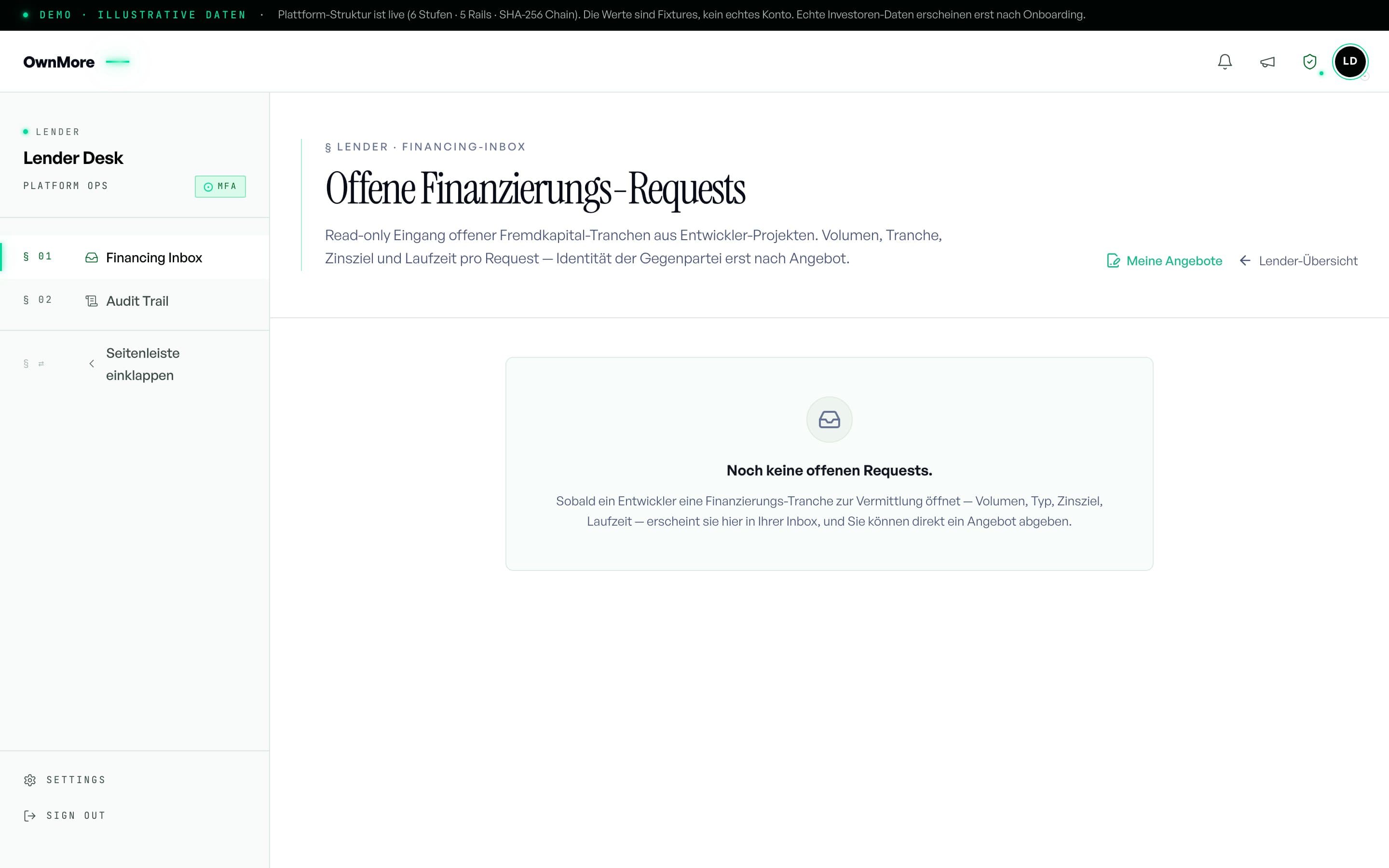
Lender Financing Inbox
Read-only inbox of open financing requests — tranche economics + project only, no identity.
The lender screens fitting tranches in an inbox instead of managing email threads.
Lender Offer Lifecycle (race-safe)
Lender submits/accepts/rejects/counters; atomic status transitions, idempotent commission.
The lender negotiates term sheets to award inside the platform; every counter survives forever in the audit.
- Live
Financing Connector Submission
Prepares bilingual submissions to generic capital categories — zero invented bank names.
- Live
Financing Commission Ledger
Idempotent commission accrual on accepted lender offers, audit-sealed and exportable.
- Live
Tamper-Evident Audit Chain
SHA-256-linked, append-only evidence chain sealing every state change — including denied access.
- Live
Role Access Spine (fail-closed)
Fail-closed enforceRole guard on every role-scoped route, as the first statement.
- Live
Notifications Inbox
Per-user inbox of relevant audit-chain events, read from Postgres not a cold-start ring.
- Live
Public Offer Journey (invite→sign→account)
Standalone /offer/[token] flow, DocuSign-style — no login loop, no backend redirect.
These surfaces are walkable live today.
Impact
Operational and commercial leverage — with no invented numbers
Faster triage
Tranche economics arrive structured and comparable instead of being extracted from each attachment — time goes into assessment, not data entry.
Ordered negotiation
A guided lifecycle with clean terminal states replaces email threads; negotiation state is unambiguous and follow-ups shrink.
No double-commit risk
Race-safe acceptance structurally rules out parallel commitments — operational risk from competing offers disappears.
Defensible evidence
The tamper-evident chain makes every step auditable — valuable for internal review, compliance or a later query.
Wider reach
A structured inbox of open tranches extends deal flow beyond the personal network — without added effort per extra request.
Pre-structured DD
The connector catalog names the required fields per capital source — DD packages are assembled cleanly once, not re-built per addressee.
Pricing
1.0% of the committed amount
from the lender · on drawdown
- Free to join — OwnMore only earns when you close.
- A fraction of today’s acquisition: no lead buys, no dunning.
- Money flows directly between the parties — OwnMore holds nothing.
The workflow
The ideal flow — from open tranche to sealed commitment
From first invite to exit — on one rail. The execution steps are live today; management, reporting and sale connect next, with the right companies and AI.
- 1
1 · Scan the inbox
The lender desk lists open tranche requests with volume, capital layer, target rate and tenor. You see the economics and project context — not the counterparty's identity.
- 2
2 · Assess the tranche
Per request you weigh layer (senior/junior/mezzanine/equity), amount and rate band against your book — structured and comparable instead of read out of an attachment.
- 3
3 · Submit an offer
You submit a structured offer: capital layer, amount, indicative rate, tenor and conditions. The developer sees that offers exist — your identity stays protected until terms are agreed.
- 4
4 · Negotiate via counter
A counter is a fresh, cleanly linked record (round +1); the prior offer moves to 'countered'. Negotiation state is unambiguous at every moment.
- 5
5 · Acceptance — race-safe
When the developer accepts, exactly one offer wins structurally; competing offers are rejected in the same operation. No double-commit, no lost state.
- 6
6 · Seal & evidence
Every step seals a 'financing' block in the SHA-256 audit chain. The full lifecycle stands up as an ordered, tamper-evident trail.
- 7
7 · Prepare connector submission
For the right capital source (cantonal bank, Pfandbrief, mezzanine fund, institutional or equity) the grounded catalog supplies the exact data list required — with no fabricated banks or terms.
- 8
Monitor & repay
PlannedMonitor covenants, interest and amortisation on the rail — repayment audit-sealed.
Trust & security
Why the desk is professional and safe
- Fail-closed role access: enforceRole(['lender']) is the first statement of every financing route — anyone who is not a lender (or admin) sees no tranche.
- Identity firewall: at the inbox and offer stage you see the tranche and project context, never the counterparty's email/ID.
- Tamper-evident SHA-256 audit chain: every financing step seals a 'financing' block with actor role — even denied access is sealed.
- Race-safe state transitions: acceptance wins structurally via a WHERE-guarded transition — no double-commit, no lost state.
- Production safety: the financing store enforces real persistence — production never silently falls back to in-memory.
- No fabricated counterparties: the connector catalog names generic capital categories, never a fabricated bank, IBAN or rate.
- Access revocable at any time — the owner keeps full authority.
- FADP/GDPR-aligned — strict Swiss data-protection standards.
FAQ
Frequently asked questions
Is the lender desk genuinely usable or just a surface?
Do I hand over control of my financing decision with OwnMore?
Where do the counterparties come from — are these invented banks?
How safe is my data and the negotiation trail?
What happens when two offers compete on the same tranche?
Does AI already do the underwriting here?
Why now, why OwnMore
Why now
Swiss real-estate financing runs today on scattered, unauditable correspondence. Whoever first makes deal flow structured and evidenced becomes the first address for open tranches.
Why OwnMore
OwnMore is infrastructure through which you act yourself — the lender desk is real and live: a DB-backed inbox, a full race-safe offer lifecycle, a tamper-evident audit chain and a grounded connector catalog with no fabricated counterparties. Not a placeholder — a working desk.
Next step
Next step: a 30-minute live demo against your real tranche criteria — inbox, offer, counter, acceptance, audit chain.
Book a live demo